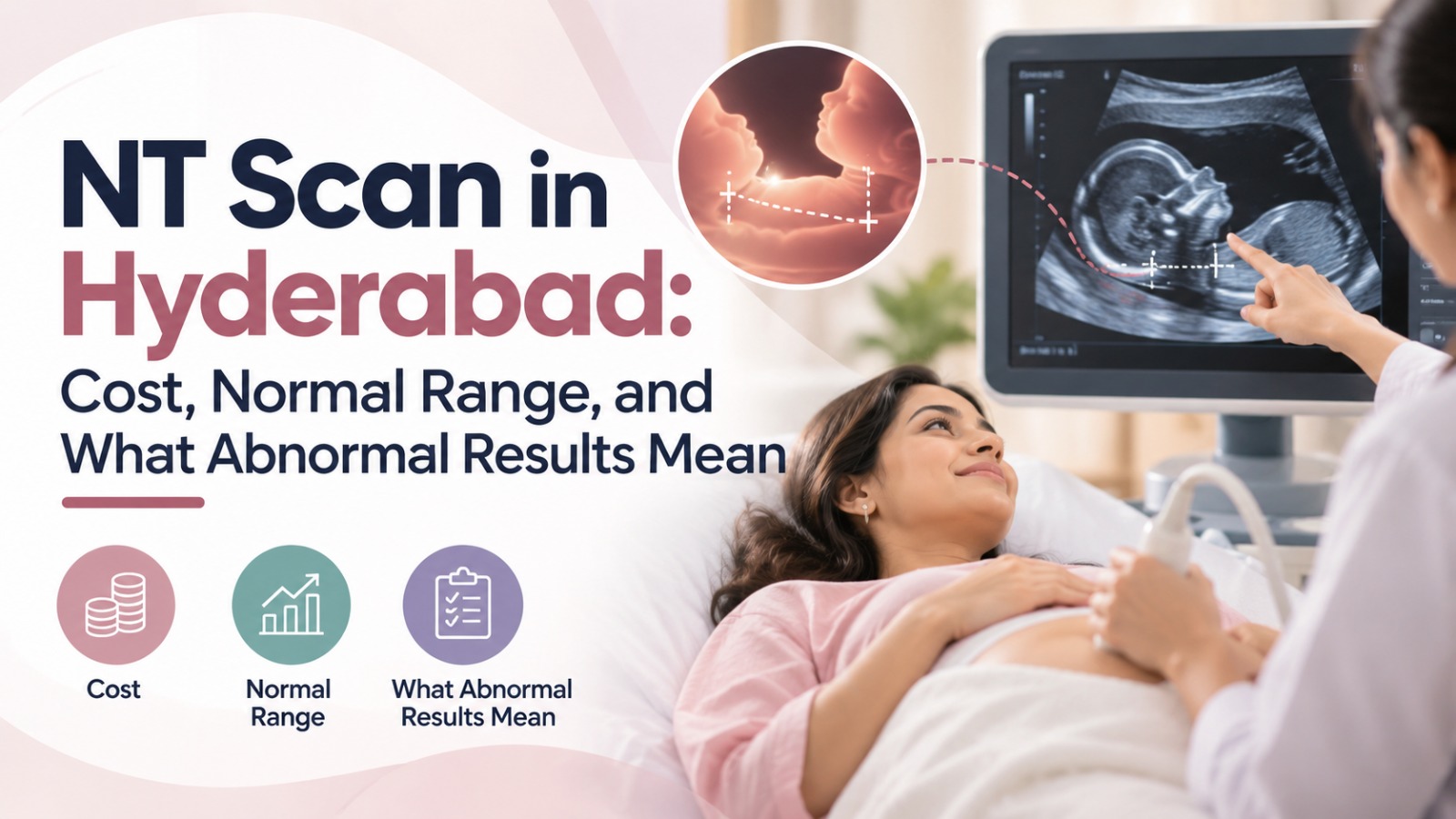
Receiving a “high-risk” double marker or NIPT report can be frightening. The most important thing to know is that a screening test only estimates risk. It does not confirm a diagnosis. Many women with a high-risk result go on to have a healthy baby.
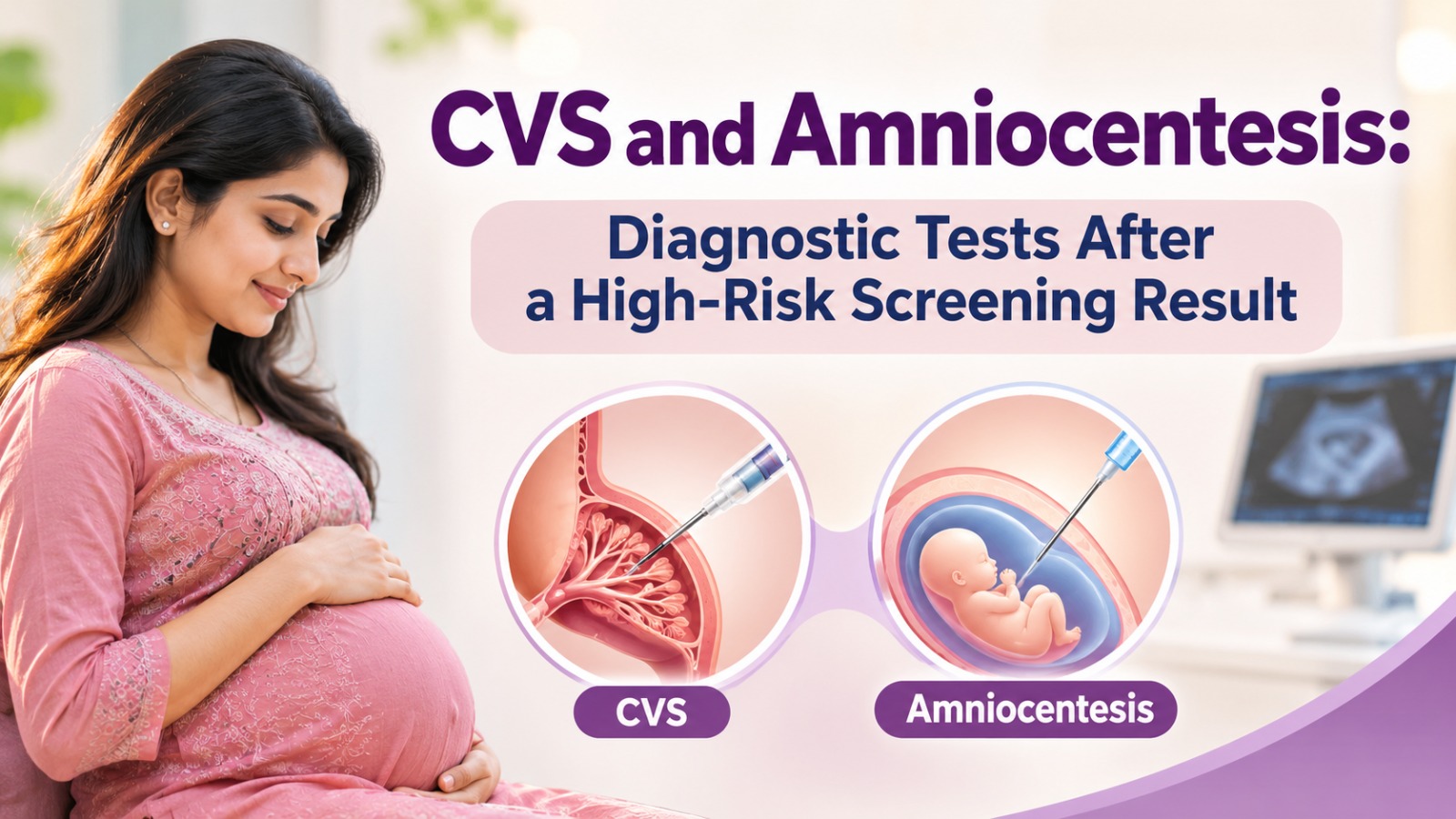
To get a definite answer, doctors offer diagnostic tests, mainly CVS (chorionic villus sampling) and amniocentesis. This guide explains what each test is, when it is done, how safe it is and how to decide between them.
Screening vs Diagnostic Tests: What Is the Difference?
- Screening tests (double marker, NIPT, NT scan) estimate the chance of a chromosomal condition such as Down syndrome. They carry no risk to the baby but cannot give a yes-or-no answer.
- Diagnostic tests (CVS and amniocentesis) analyse the baby’s actual genetic material and can confirm or rule out specific conditions with very high accuracy.
Because diagnostic tests are invasive, they are usually advised only when screening suggests a higher chance of a problem or when there is another clear reason.
When Are CVS or Amniocentesis Recommended?
Your doctor may suggest one of these tests if you have:
- A high-risk double marker or NIPT result
- An abnormal finding on the NT scan or TIFFA (anomaly) scan
- A previous baby or a family history of a chromosomal or genetic condition
- Parents who are carriers of a genetic disorder such as thalassemia or cystic fibrosis
- Advanced maternal age, usually 35 or above, when you want a definite answer
- A previous pregnancy affected by a chromosomal abnormality
Having either test is always your choice. A genetic counseling session helps you decide.
What Is CVS (Chorionic Villus Sampling)?
CVS tests a tiny sample of chorionic villi, finger-like tissue from the placenta that has the same genetic makeup as the baby.
When is it done? Usually between 11 and 14 weeks of pregnancy, which makes it the earliest diagnostic option.
How is it done?
- A detailed ultrasound confirms the baby’s position and the placenta’s location.
- After cleaning the skin, a thin needle is passed through the abdomen (transabdominal) under continuous ultrasound guidance. In some cases a thin catheter is passed through the cervix.
- A very small placental sample is collected.
- The procedure takes only a few minutes, and the whole visit usually lasts under an hour.
What can it detect? Chromosomal conditions like Down syndrome (trisomy 21), Edwards syndrome (trisomy 18) and Patau syndrome (trisomy 13), and many single-gene disorders such as thalassemia, sickle cell disease and cystic fibrosis when the parents’ mutation is known.
Limitations: CVS cannot detect open neural tube defects such as spina bifida. In a small number of cases the placenta shows a result different from the baby (called confined placental mosaicism), and a repeat test may be advised.
What Is Amniocentesis?
Amniocentesis tests a small sample of amniotic fluid, the fluid around the baby, which contains the baby’s cells. In Telugu it is commonly called ఉమ్మనీరు పరీక్ష.
When is it done? Usually from 15 or 16 weeks onward, most often between 16 and 20 weeks.
How is it done?
- An ultrasound locates a safe pocket of fluid.
- A thin needle is passed through the abdomen under ultrasound guidance, and about 15 to 20 ml of fluid is withdrawn.
- The procedure takes a few minutes. It is done as a day-care visit, and you can go home the same day.
What can it detect? All the chromosomal conditions CVS can, many genetic disorders, and, through fluid analysis, open neural tube defects. It can also test for certain infections when needed.
CVS vs Amniocentesis: Key Differences
| Feature | CVS | Amniocentesis |
|---|---|---|
| Timing | 11 to 14 weeks | From 15 to 16 weeks |
| Sample taken | Placental tissue | Amniotic fluid |
| Neural tube defects | Not detected | Can be assessed |
| Placental mosaicism | Possible | Rare |
| Main advantage | Earlier answer | Slightly lower procedure risk |
The right test depends on your gestational age, the reason for testing and your doctor’s advice.
How Accurate Are CVS and Amniocentesis?
Both tests are highly accurate, with results above 99% for the conditions they test for. A small proportion of samples may need repeating or give an unclear result, and your doctor will explain what this means for you.
How Long Do the Results Take?
- Rapid results for common chromosomal conditions (QF-PCR or FISH) are often ready within 2 to 4 days.
- Full chromosomal analysis (karyotype or microarray) usually takes 1 to 3 weeks.
- Specific gene tests may take longer, depending on the condition.
Are CVS and Amniocentesis Safe? Risks Explained
Both are generally safe when performed by an experienced fetal medicine specialist under ultrasound guidance, but they carry a small risk of miscarriage, usually quoted as well below 1%. Other possible effects include:
- Mild cramping or spotting for a day or two
- Rarely, leakage of fluid or infection
- Sensitisation in Rh-negative mothers, which is prevented with an anti-D injection
The expertise of the doctor performing the procedure matters. Higher experience is linked with lower complication rates.
What to Expect Before and After the Test
Before: A detailed scan, blood group check and counseling session. You can eat normally, and your doctor will tell you about any medicines to avoid.
After:
- Rest for the remainder of the day and avoid heavy lifting or strenuous activity for 24 to 48 hours.
- Mild period-like cramps can be normal.
- Contact your doctor if you have heavy bleeding, fluid leakage, fever or severe pain.
CVS and Amniocentesis Cost in India
The cost of a CVS test or amniocentesis in India varies by city, hospital and the type of genetic analysis ordered. A simple chromosomal analysis costs less than a full microarray or a specific gene test. For an exact estimate, ask the centre for a breakdown that includes the scan, the procedure, the lab test and any follow-up visits.
CVS and Amniocentesis in Hyderabad: Why Choose a Fetal Medicine Specialist
These procedures call for precise ultrasound skills and a steady hand. A fetal medicine specialist also provides the counseling you need before and after the test, so you understand your options and feel supported at every step.
If you are looking for amniocentesis in Hyderabad or a CVS test in Hyderabad, Dr. Navya KC offers detailed prenatal diagnosis, genetic counseling and compassionate care for high-risk pregnancies. Book a consultation to discuss your screening result and the next best step.
Frequently Asked Questions
What is the difference between CVS and amniocentesis?
CVS tests placental tissue at 11 to 14 weeks, while amniocentesis tests amniotic fluid from about 15 weeks.
Is amniocentesis painful?
Most women feel brief pressure or mild cramping rather than significant pain.
Is a high-risk NIPT or double marker result a confirmed diagnosis?
No, it only means a higher chance, and a diagnostic test is needed to confirm.
How safe is amniocentesis?
It is generally safe in expert hands, with a small risk of miscarriage well below 1%.
Can CVS detect spina bifida?
No, neural tube defects are assessed with amniocentesis and detailed ultrasound.
How soon are CVS results available?
Rapid results take about 2 to 4 days, and full results about 1 to 3 weeks.
Do I need bed rest after amniocentesis?
Rest for the day and avoid strenuous activity for 24 to 48 hours.
Is amniocentesis mandatory after a high-risk result?
No, it is always your decision after counseling.
Can I go home the same day?
Yes, both procedures are done as day-care visits.
Final Thoughts
A high-risk screening result is a reason for clarity, not panic. CVS and amniocentesis can give you a definite answer, and both are safe when done by an experienced specialist. Whether to have either test is a personal decision, best made after counseling. Speak to a fetal medicine specialist early, as the timing affects which test is available.
Disclaimer: This article is for general educational purposes only and is not a substitute for professional medical advice, diagnosis or treatment. Please consult a qualified doctor regarding your pregnancy and health.

.jpeg)